Nesting Broad-winged Hawks in Texas are not a common sight in my part of Texas. The southeastern part of Harris County sees many Broad-winged Hawks during both spring and fall migrations. However nesting pairs are rarely seen here.
Birds don’t always follow convention and it appears as though that is the case on my property this year.
Over the past few weeks a pair of Broad wings have built a nest in a tall pine above my driveway in a residential neighborhood. We frequently see nesting Red shouldered Hawks and their fledglings, but this is the first nesting Broad-winged Hawk I have seen in the twenty+ years I’ve lived here.
Although there a numerous records of nesting Broad winged Hawks in Texas, this pair seems to be on the southwestern fringe of historical data.
“There are two nesting populations in Texas. The eastern one is in lowland and upland forests, mostly east of the Trinity River. The other is further west, separated by Blackland Prairie, and ranges along the Balcones Escarpment between Travis and McLennan counties. The range broadens in the area of Parker, Tarrant, and Dallas counties north to Montague, Cooke, and Grayson counties (Pulich 1988, TBBA records, FRG). This central to north-central population is expanding.” 1
Regardless, it’s great to have them here and follow their progress. Below are a few pics of one of the birds and the nest high in a pine tree.
If all goes well I hope to get some more shots when the kids arrive and fledge. Check back periodically as to see the progress of these intriguing raptors.


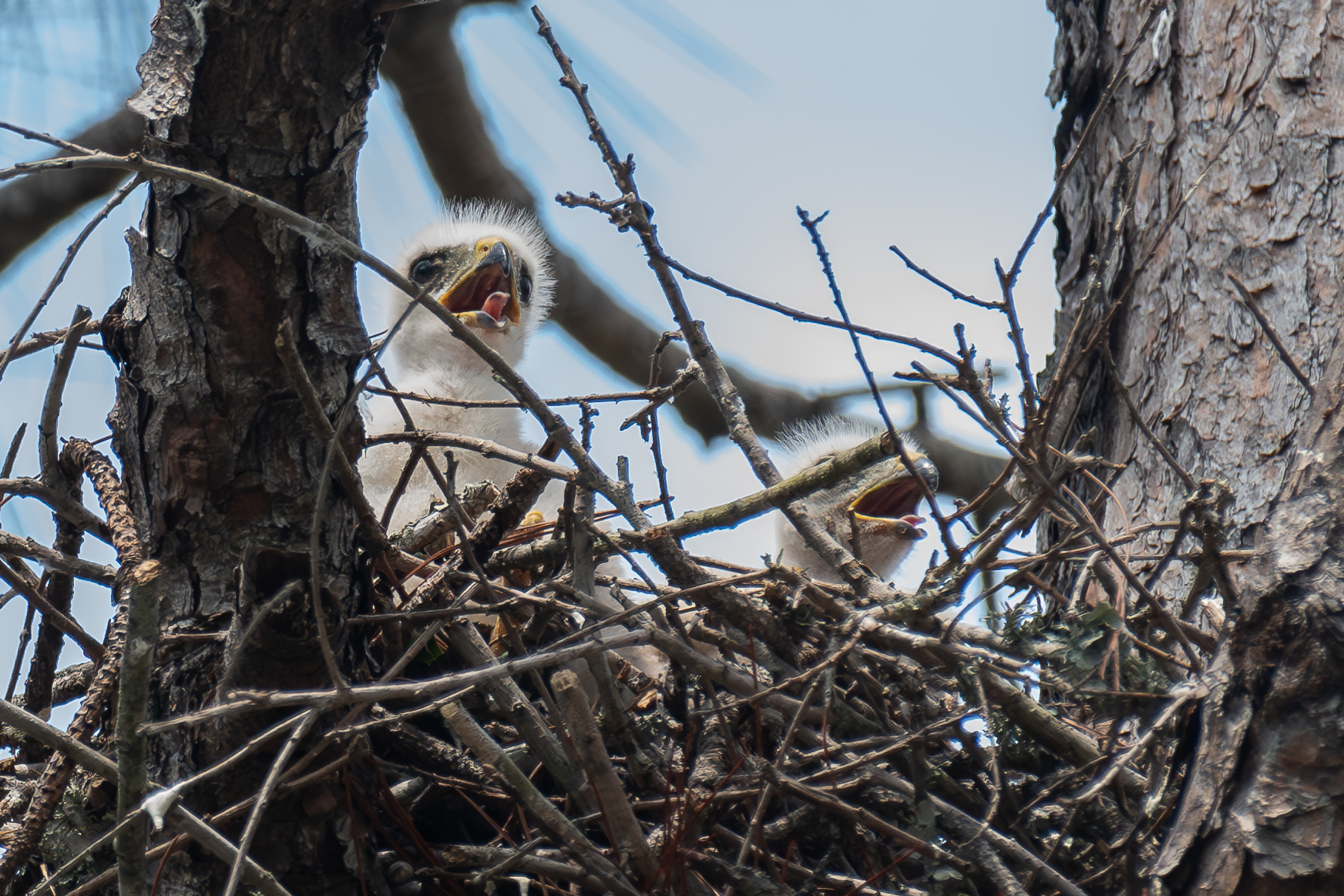
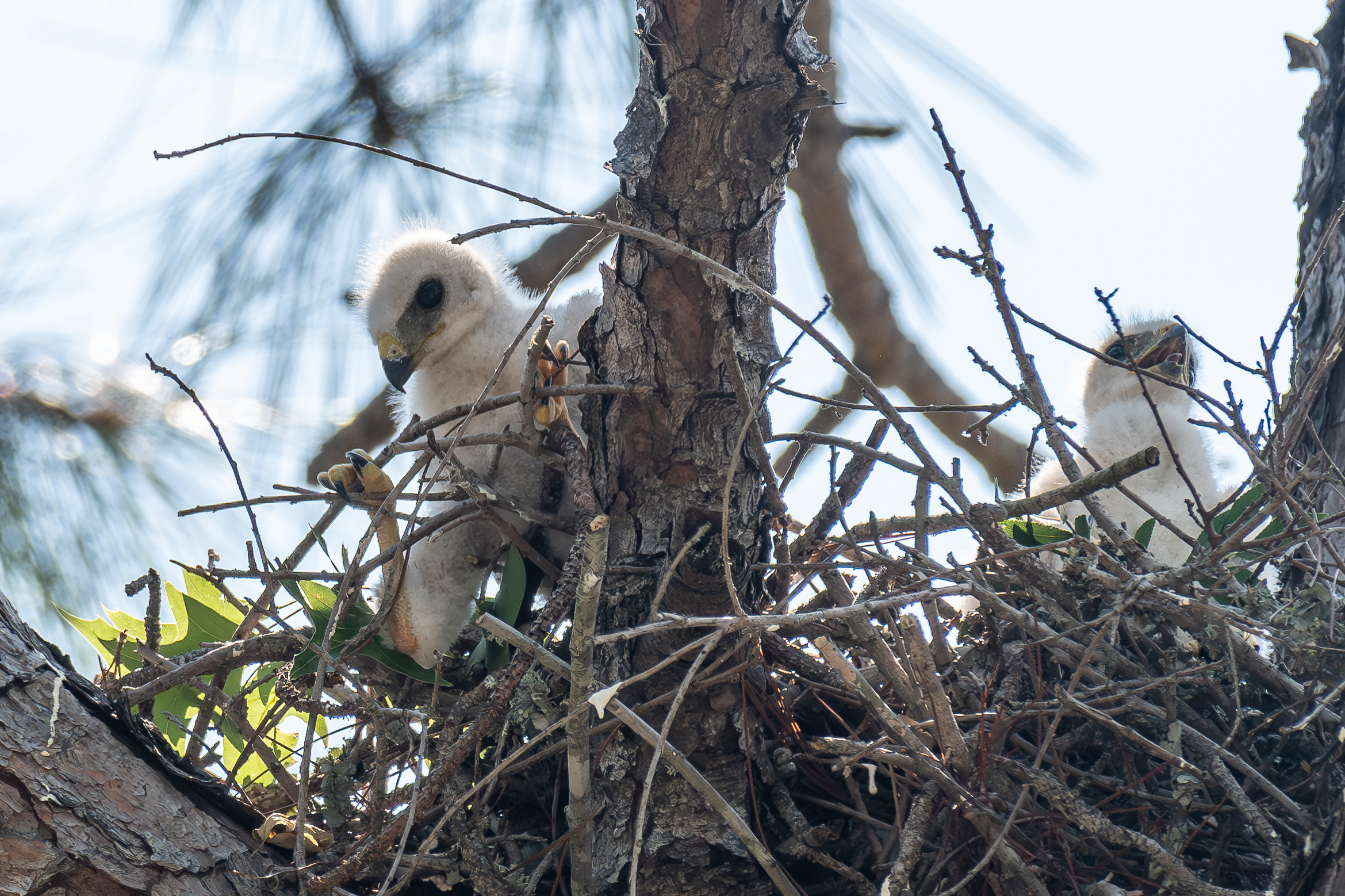
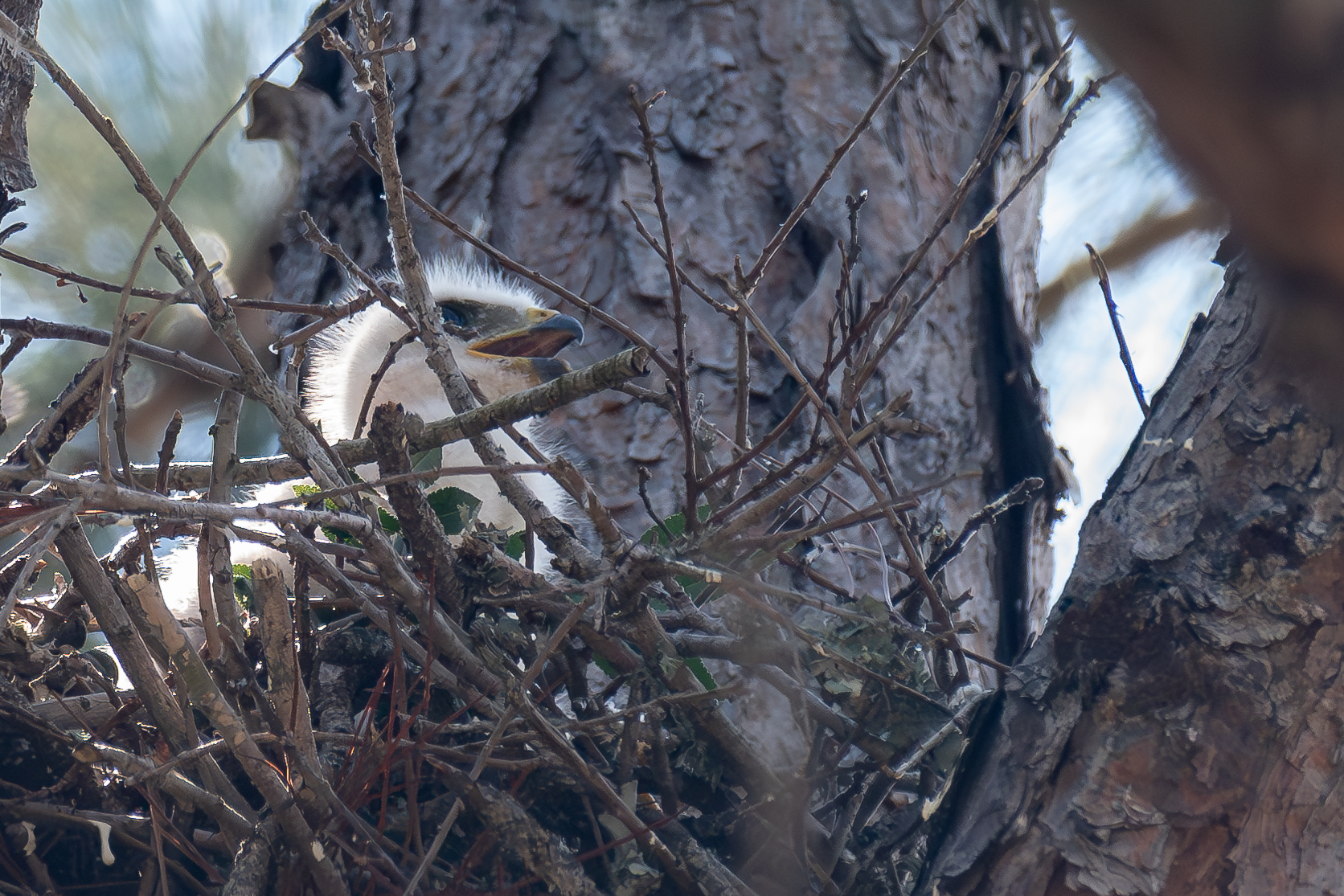
Natal Down
Present primarily May–Jul, in the nest.
Light Morph. At hatching, covered with short, dirty white down (Wetherbee and Wetherbee 1961). Thick white prepennae down, basally grayish, emerges after several days (Burns 1911, Bent 1937b, Wetmore 1965b, Lyons and Mosher 1987). 2
Primary Feathers
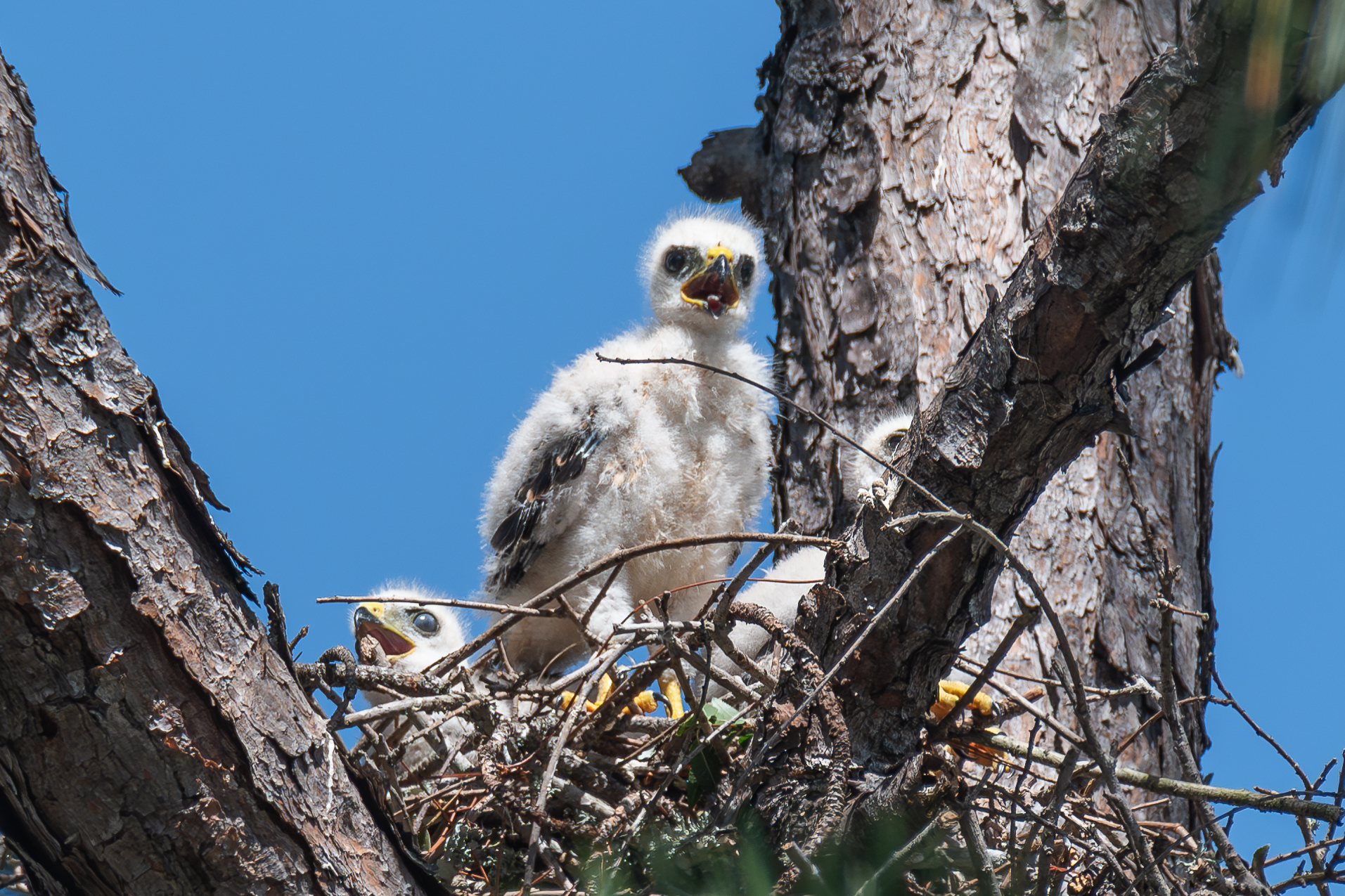
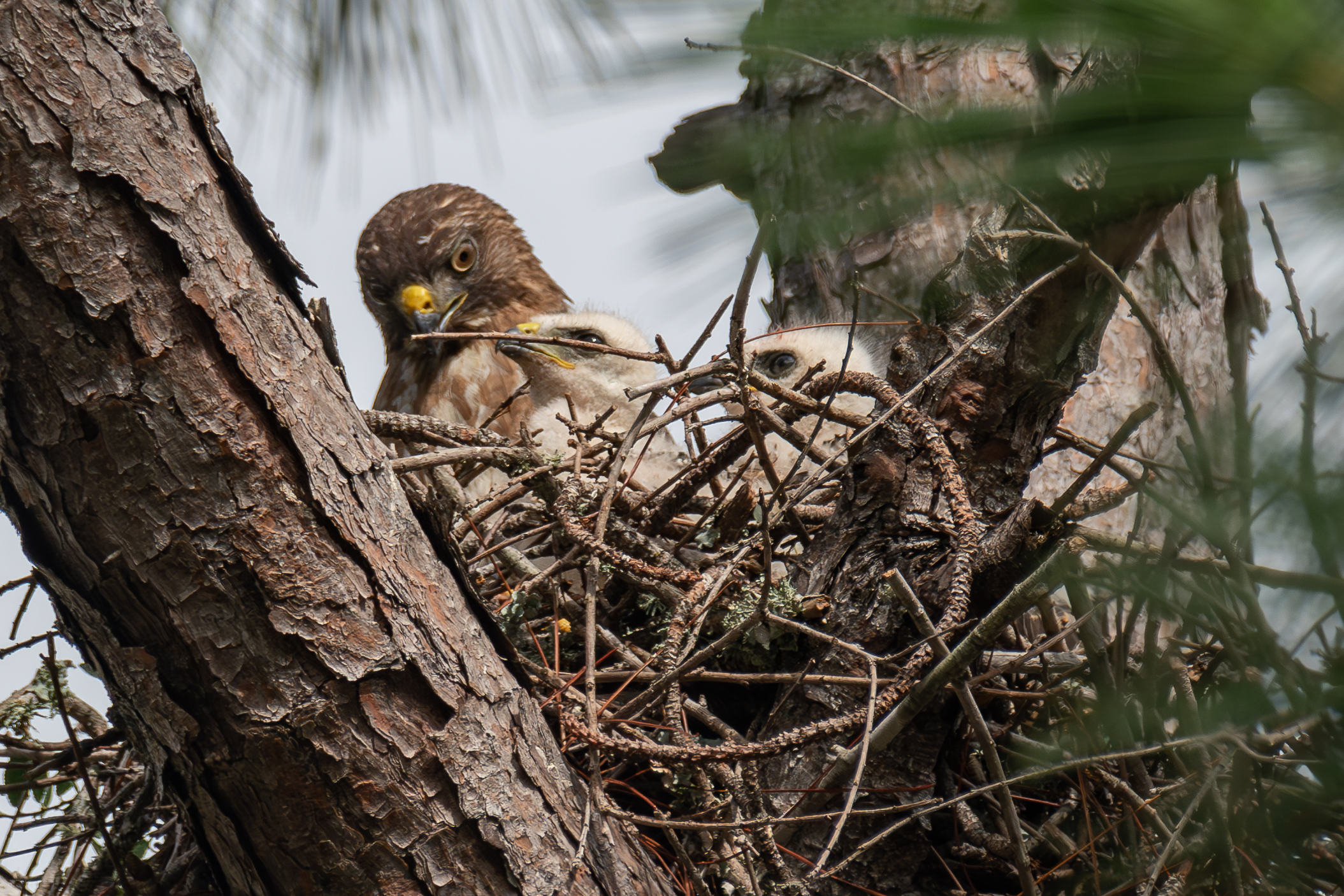
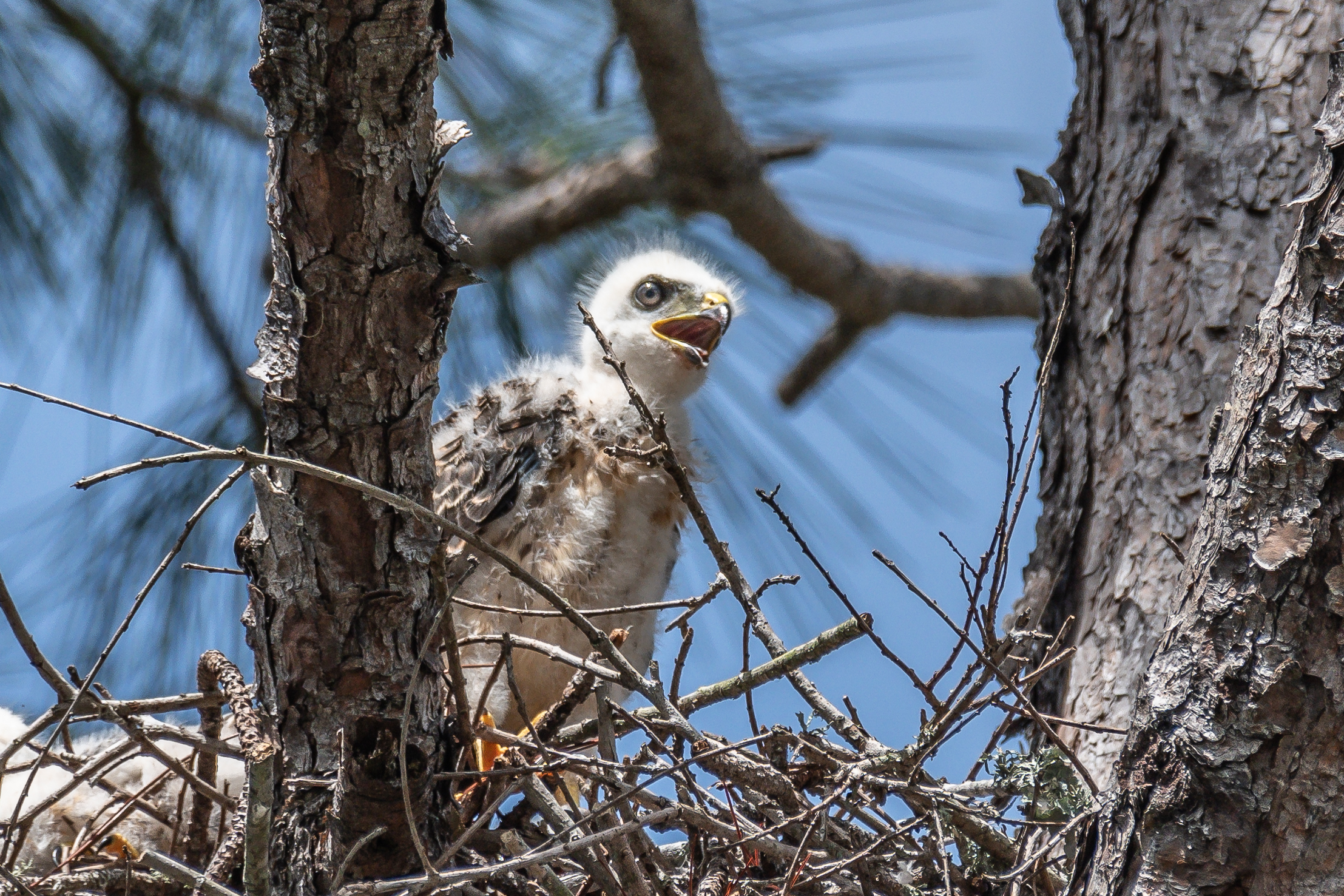
While taking a few images of the growing nestlings, an additional head popped up today. Primary feathers appear at about 9 days so I’m assuming the nestling showing them is about that age.
Heavy Weather and Broad-winged Hawk Nestlings
The passage of Tropical Storm Alberto to our south brought heavy rain and wind over the past 2 1/2 days. The female kept the nestlings sheltered and was doing a bit of nest maintenance today. With the onset of better weather, the chicks seem to be fine and active. I estimate the oldest chick is ~ 12 days old
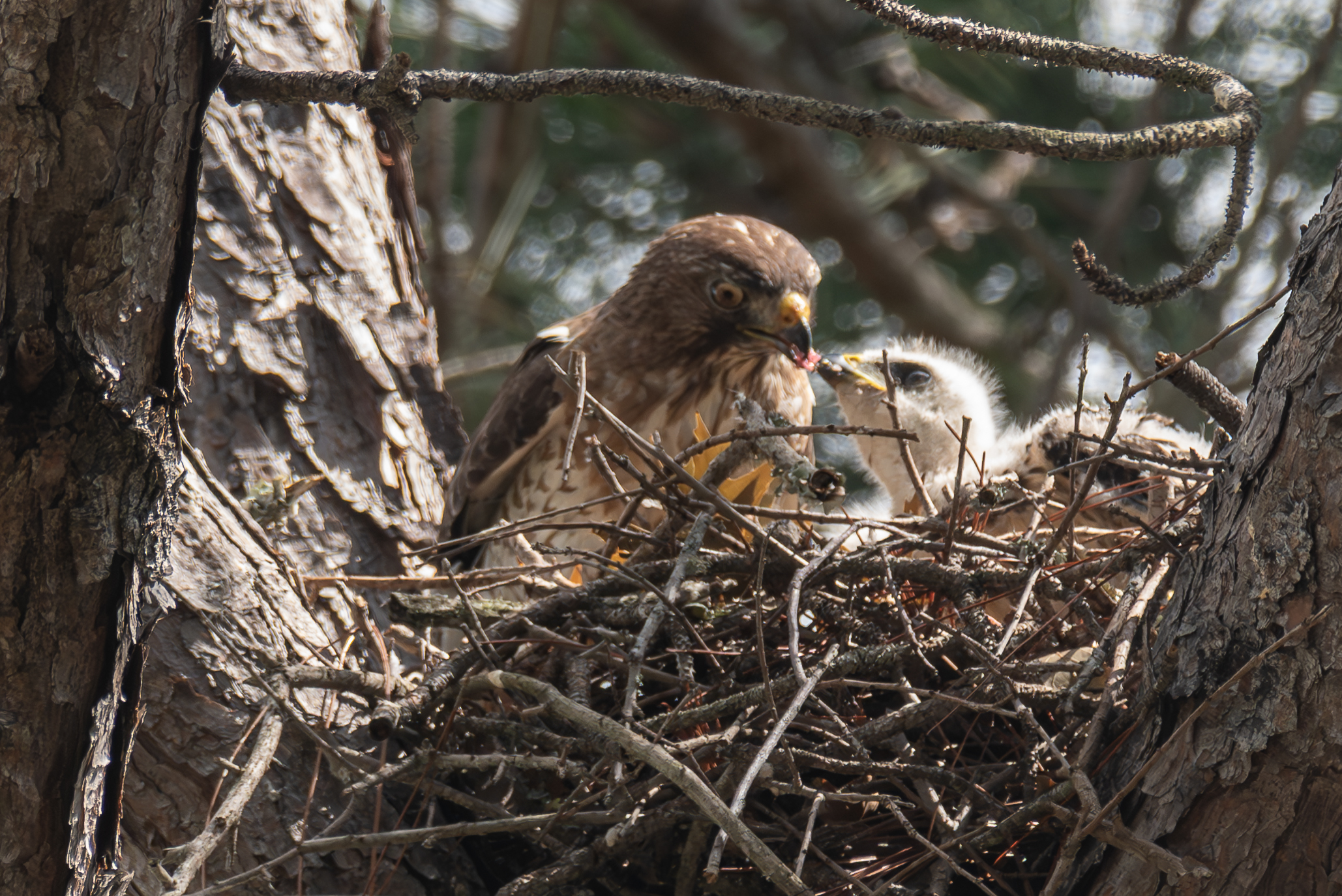
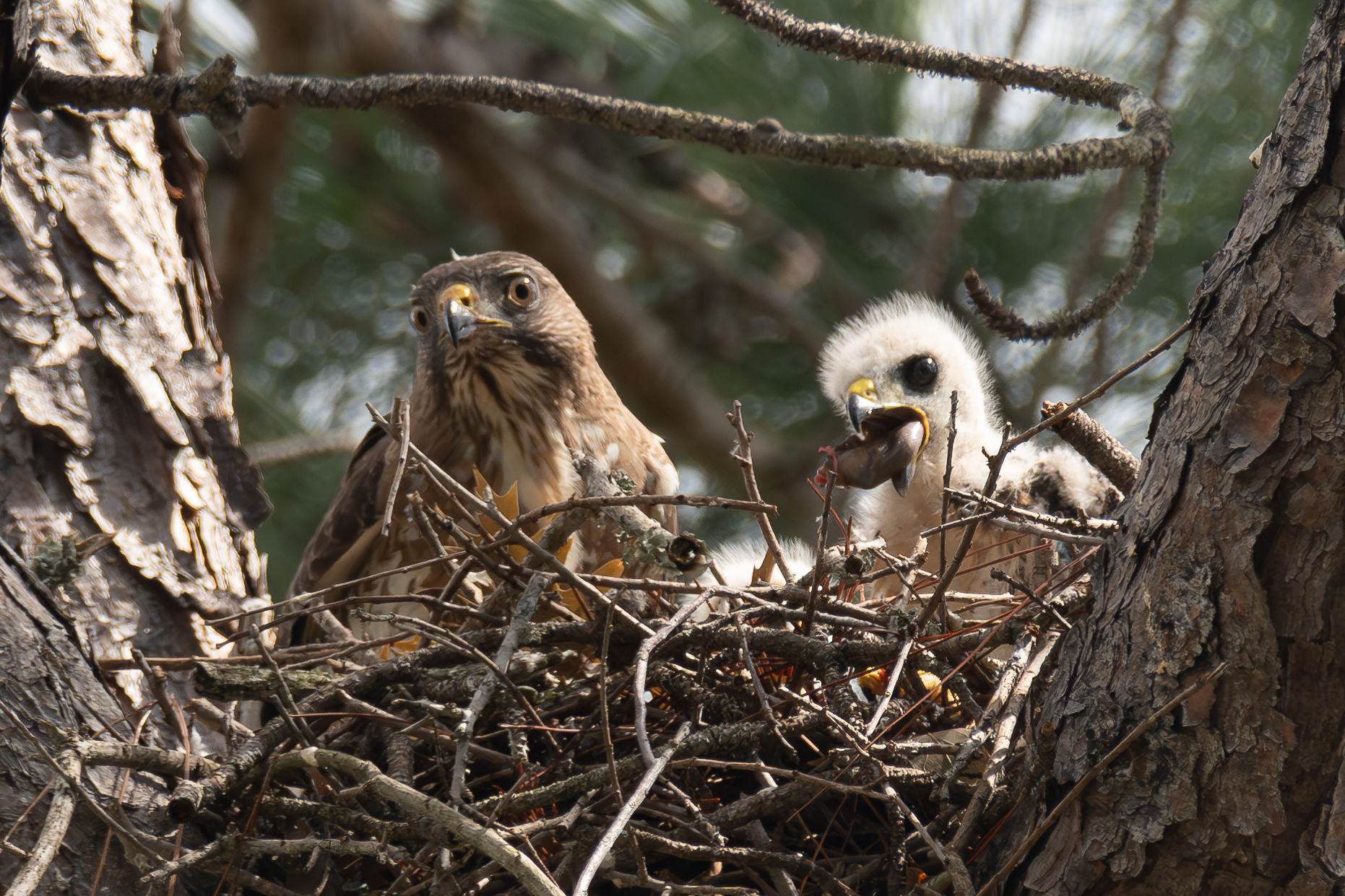
Feeding Time – June 21st, 2024
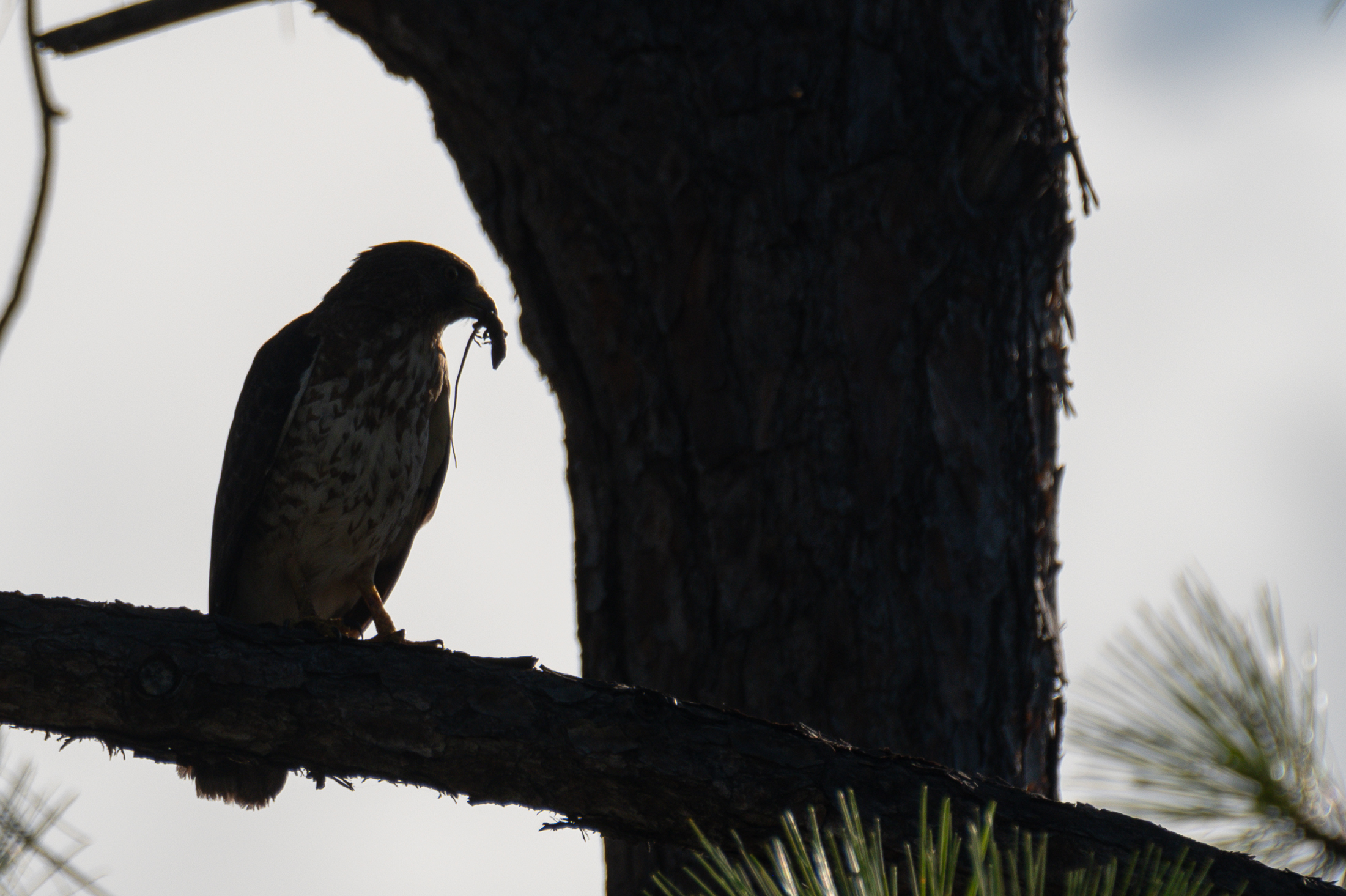
“Only female feeds young; male brings prey to her away from nest or drops prey on nest if female is absent (Matray 1974). Female tears up prey and feeds young; will pick up dropped pieces and offer again. Feeding continues for first 2–3 wk (Holt 1959, Matray 1974). Each feeding bout lasts approximately 9 min (range 2–50, n = 94), with 4–16 deliveries/d in New York (Matray 1976), average 1.94 deliveries/d over first 5 wk in Kansas (Fitch 1974). In Puerto Rico, prey delivery to chicks averaged 0.38 items per chick/h (range 0.14 -0.80; Hengstenberg and Vilella 2005). Occasionally >1 prey item fed to young at a single bout; this is usually the result of male depositing a prey item at nest when female is absent (Matray 1974).” 2
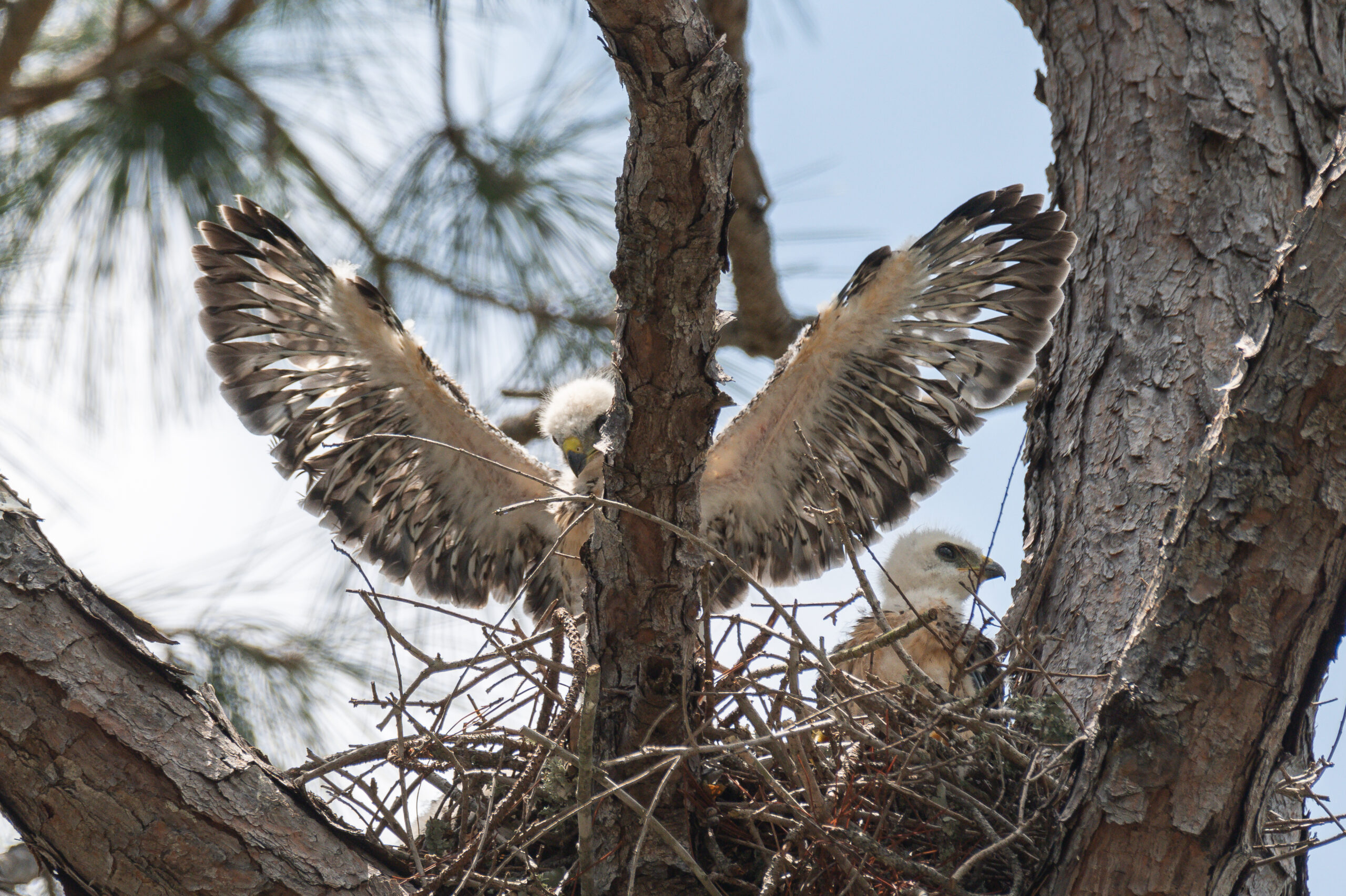
Testing the Wings
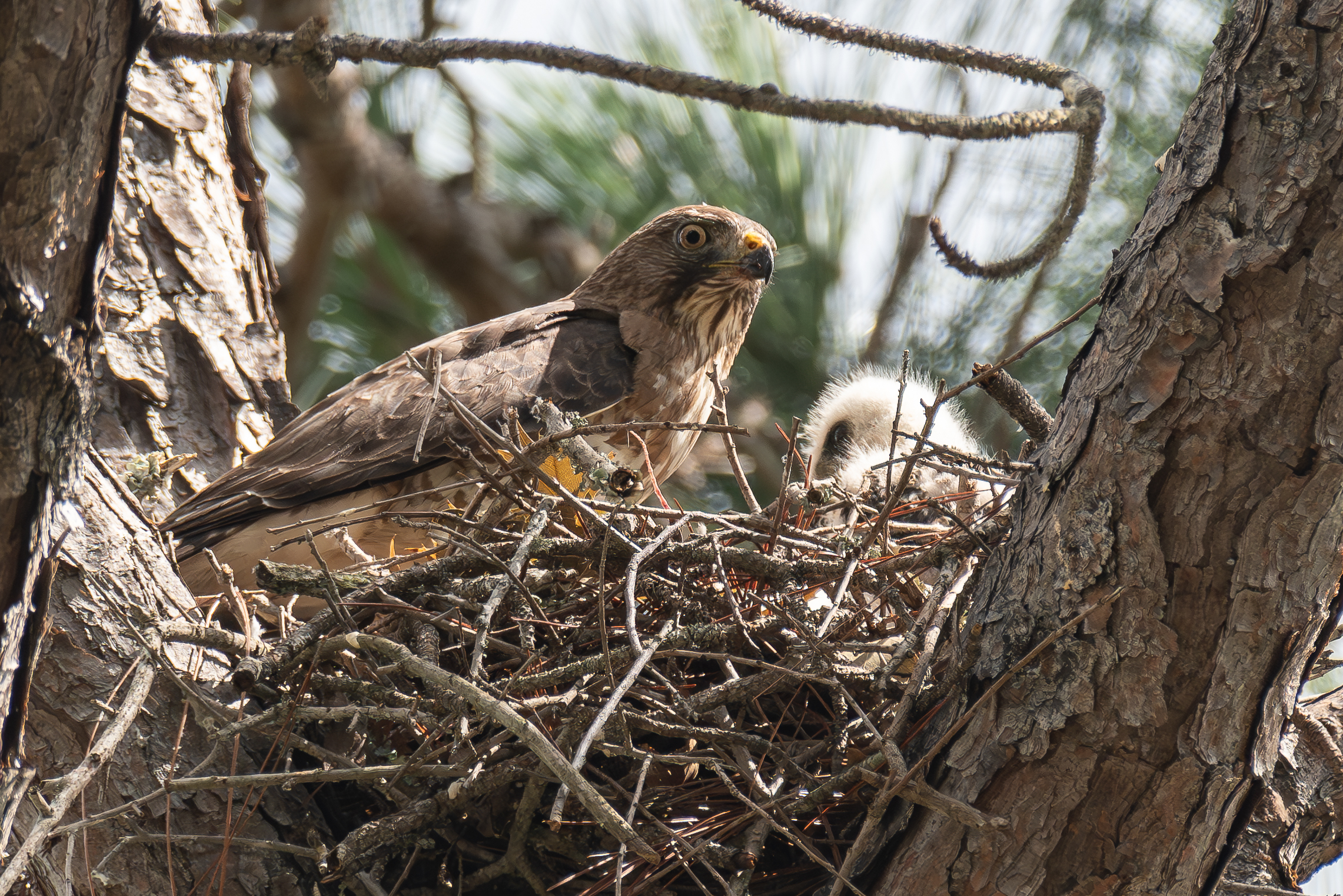
What I believe to be the oldest of the three chicks, seems to have discovered his wings.
The male handed off a small snack (a lizard) to the female, who dropped it in the nest and perched nearby.

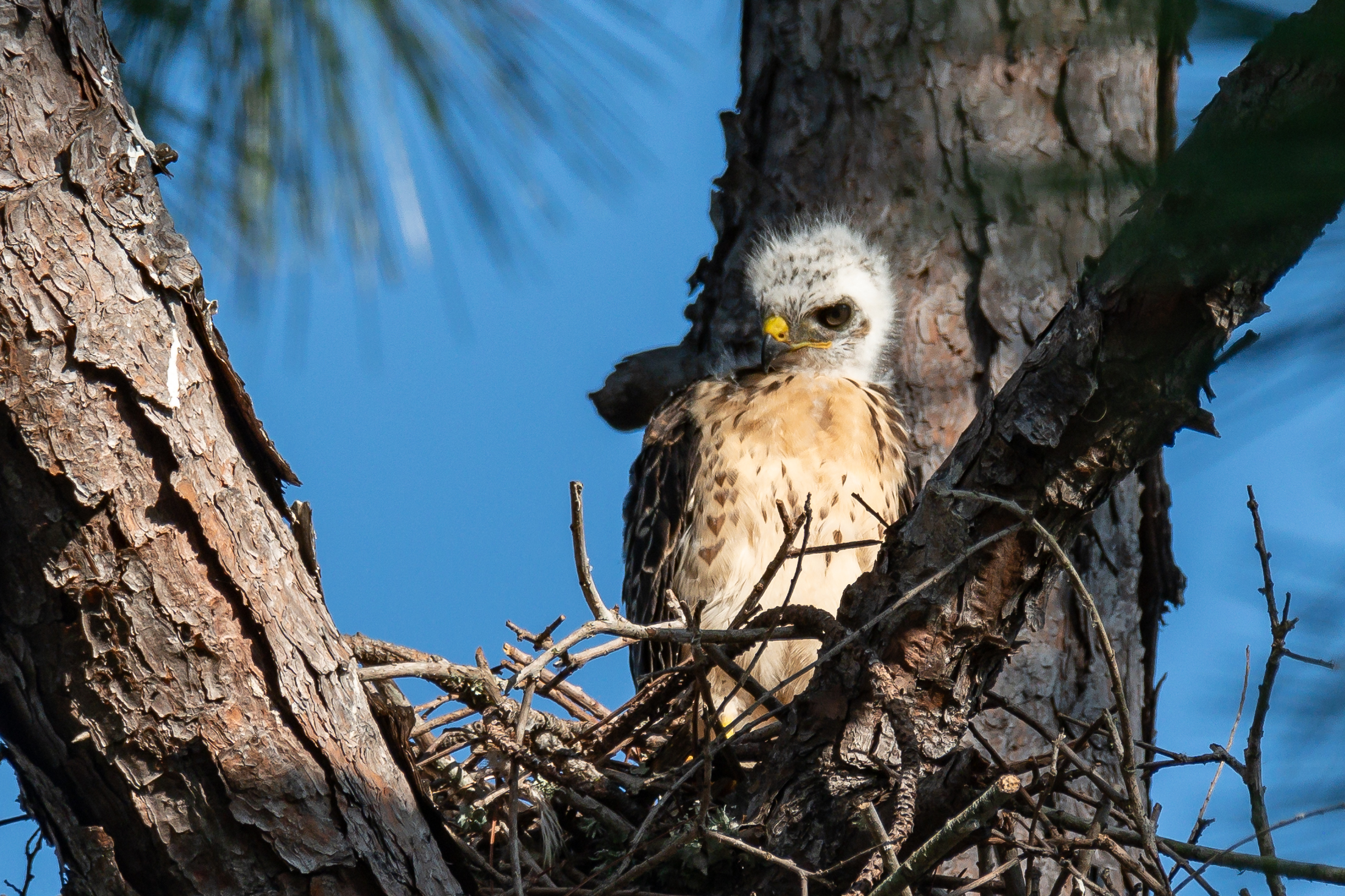
All is well at the nursery. Still three healthy chicks rapidly growing. I estimate ~ 19 days old – June 27, 2024
Young Broad-winged Hawks explore
The young hawks are venturing out of the nest and exploring their tree nursery.
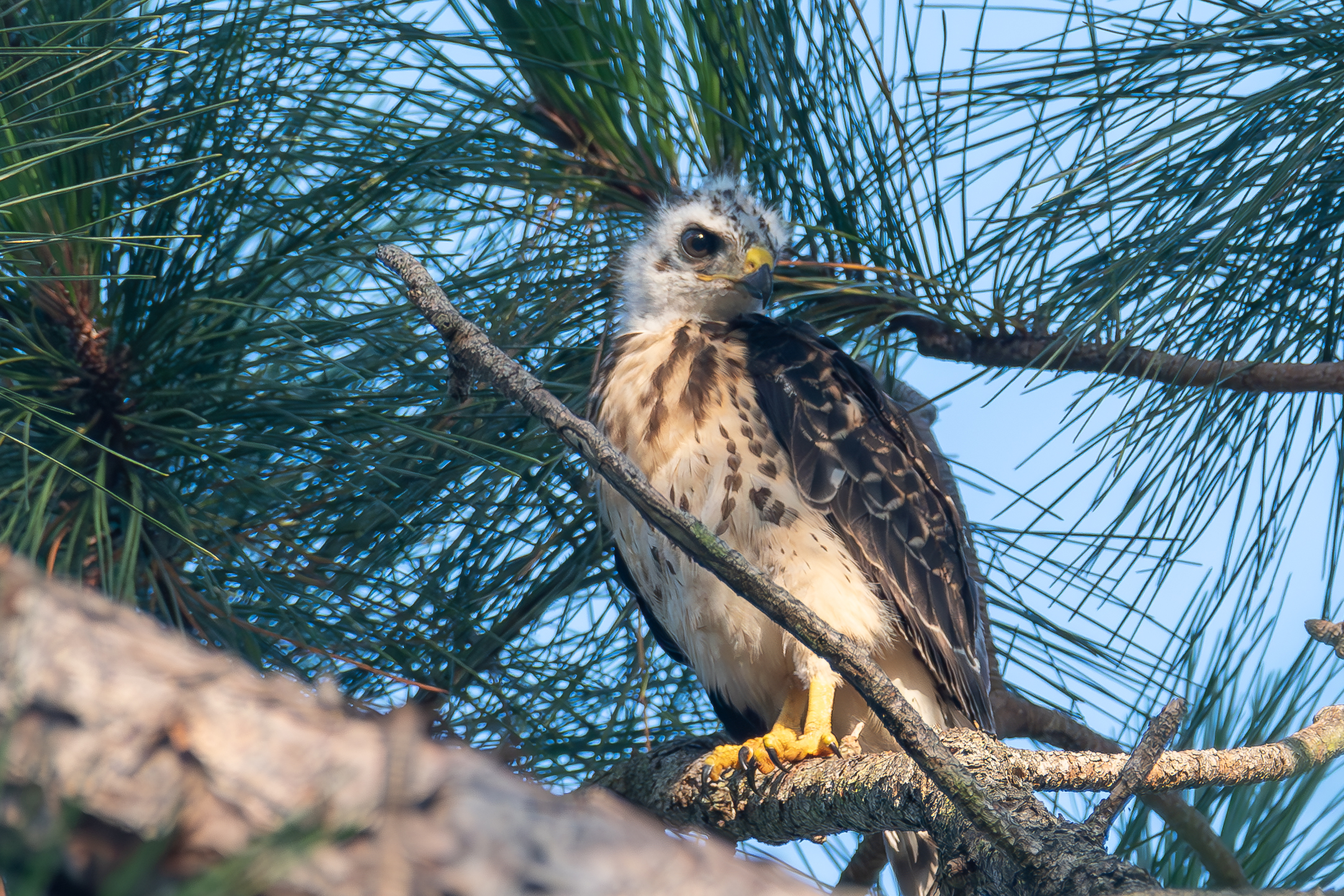
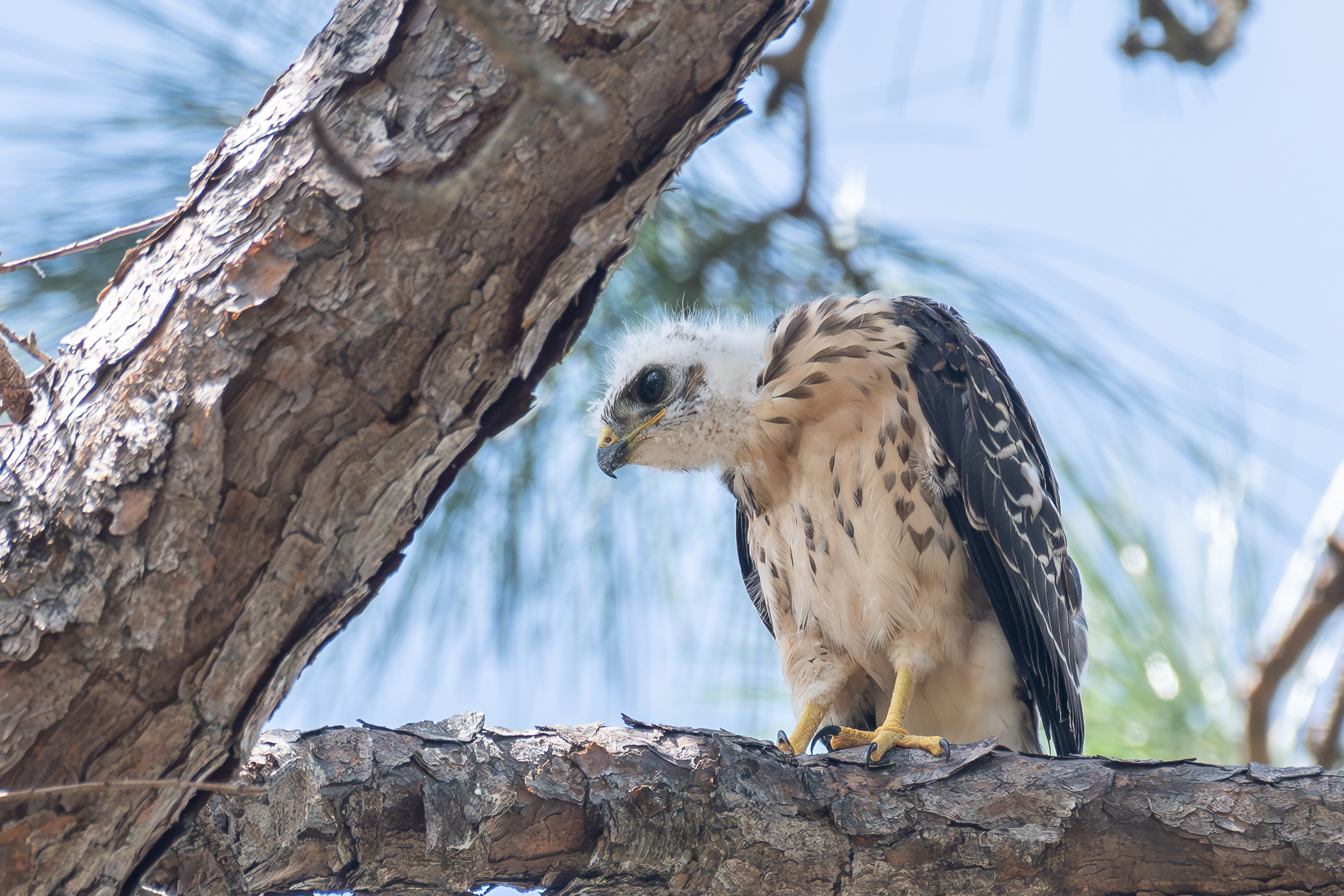
All three young Broad-wings are out of the nest most of the time and perching in the nest tree. Adult female is watching from nearby.

For some additional info on Broad-wings, see my previous post Broad winged Hawk in Texas

And then there were two?
Over a period of the past few days the young Broad-winged Hawks have roamed away from the nest tree. I have only been able to locate two of the three nestlings. This morning I found quite a few feathers scattered at the base of the nest tree. I am of the opinion that the third bird has been “fratricided” or died otherwise. I too believe that it was most likely a meal for the other two.
“Fighting more frequent and violent in 3-nestling vs. 2-nestling broods, but not well studied. In w. New York, brood reduction occurred at only 3 of 11 nests (STC). Sibling aggression uncommon (10% of nest observations); occurred equally in nests with and without brood reduction (STC). Aggression usually occurs before age 11 d; older young most often the aggressor.”2
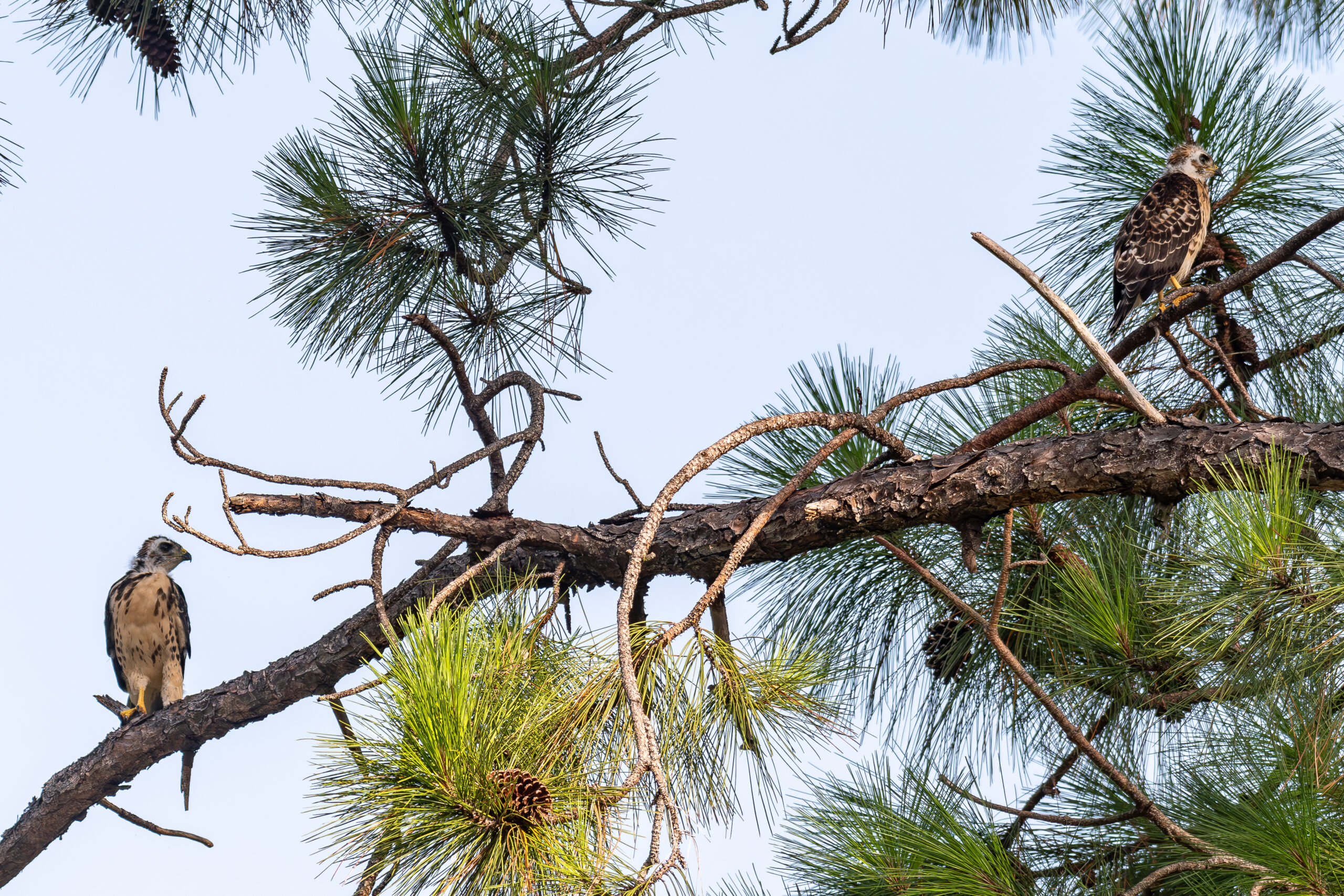
“Fighting over food and mantling of prey during week 4 (Matray 1974, J. Mosher inPalmer 1988c)”2

Broad-wings and Hurricanes
The morning of July 8th saw the passage of Category 1 Hurricane Beryl. The eye of the storm passed about 30 miles west of us. The notheastern quadrant brought us heavy rains and gusty winds. I thought about the fate of the young hawks during the storm. We had a lot of tree damage, but after the storm, the nest still stood in the tall pine. The day following the storm, I saw the adult and the two fledged youngsters at the nest tree. Since then they have been visible frequently nearby. They are fully capable of flying, but I suspect the adults are still providing some food.
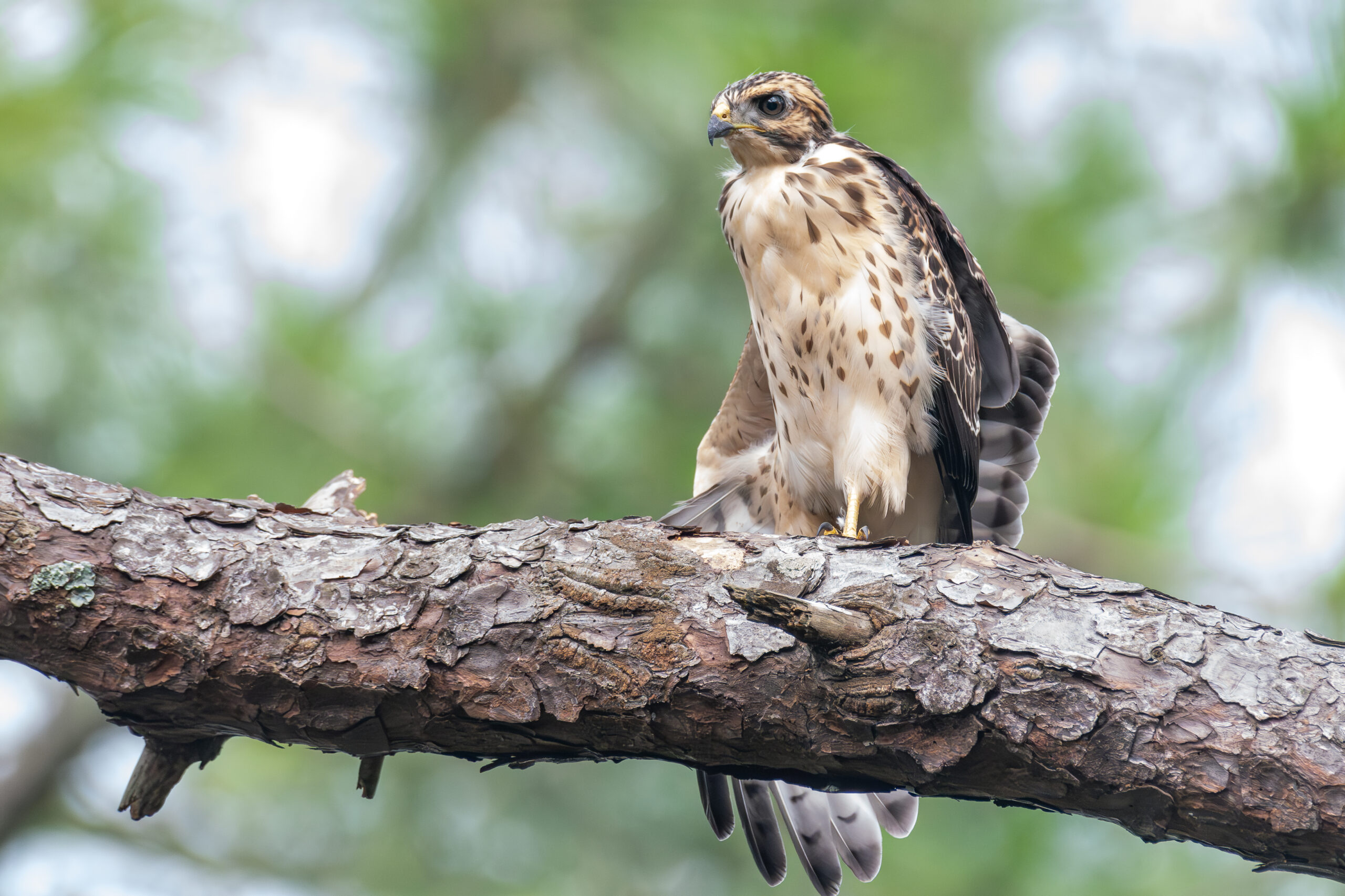
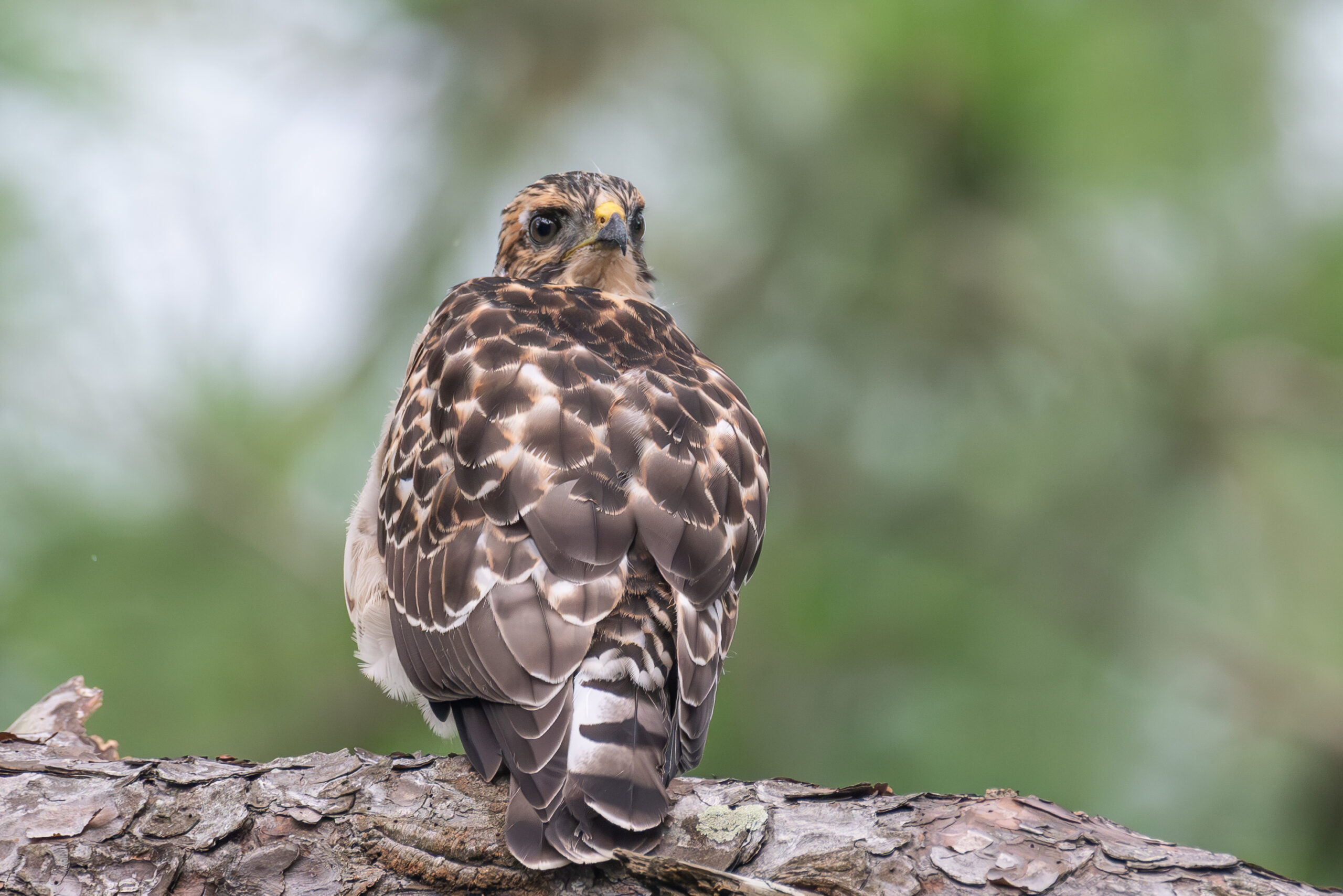
After about 6 weeks, I occasionally see the adult Broad-winged Hawk and fledglings nearby. However it seems as though they are dispersing. This brings to an end my chronicle of a successful breeding attempt by devoted parents. I trust that this post has been informative. Comments are always welcomed.
Postscript
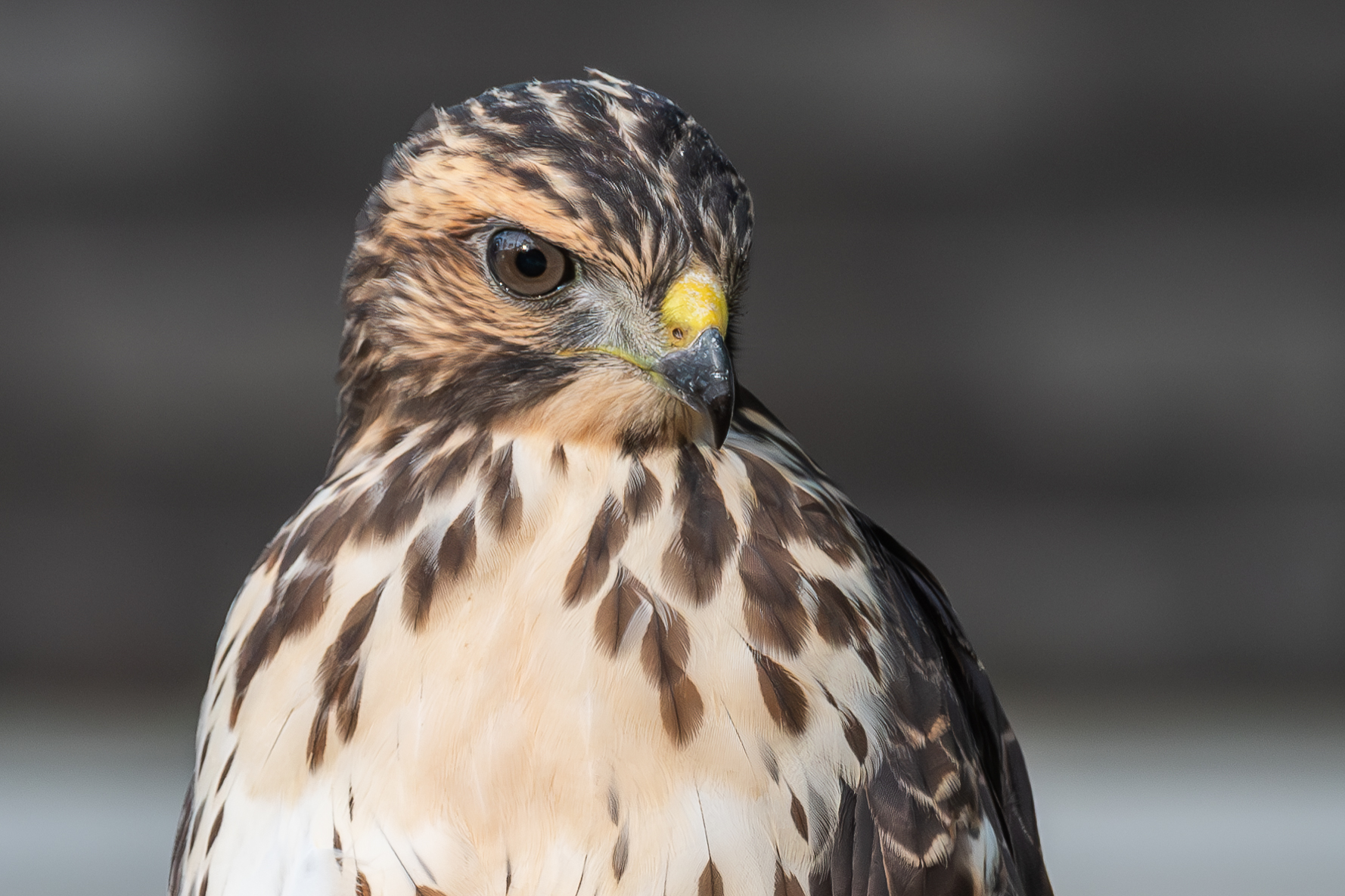
Had a visit to my backyard today. One of the fledged hawks perched on my back fence long enough to get a couple of images.
Literature cited:
Gehlbach, F. R. G. R. (n.d.). BROAD-WINGED HAWK. Texas A&M Agrilife Research. https://txtbba.tamu.edu/species-accounts/broad-winged-hawk/ 1.
Goodrich, L. J., S. T. Crocoll, and S. E. Senner (2020). Broad-winged Hawk (Buteo platypterus), version 1.0. In Birds of the World (A. F. Poole, Editor). Cornell Lab of Ornithology, Ithaca, NY, USA. https://doi.org/10.2173/bow.brwhaw.01 2.
Hello Richard,
Love seeing all your photos!
The Pine Brook HOA is planning to redo the sign at the south wetlands park and we are wondering if you would be able to provide some photos for the new sign.
Thanks!